
AECAC in Brussels: Discussions with the European Commission and the European Parliament

From 23 to 25 June 2026, the European firearms trade association AECAC held talks in Brussels with the European Commission and Members of the European Parliament. The discussions focused on the evaluation of the EU Firearms Directive, the proposed directive on firearms trafficking, and their implications for the lawful firearms trade and lawful firearms owners. AECAC was represented by its President, Michael Blendinger, who is also President of the German Association of Gunsmiths and Firearms Dealers (VDB), and its Secretary-General, Peter Brass.
“Reality Check”: Practical Problems with the Firearms Directive
On 24 and 25 June, the European Commission’s Directorate-General for Migration and Home Affairs (DG HOME) held a “Reality Check” on the Firearms Directive. This was the first time the Commission had engaged in a comprehensive exchange with the private firearms sector in this format. European and national associations representing manufacturers, dealers, shooting sports, hunting and collectors shared their experiences with the existing rules.
A key problem is so-called “gold-plating”: some Member States implement EU requirements more stringently than required. This results in divergent national rules, hampers cross-border activities and runs counter to the objective of a harmonised internal market. AECAC therefore called for uniform, legally clear and workable rules, together with less bureaucracy, without compromising internal security.
Among other proposals, Blendinger suggested extending the general transfer authorisation for licensed commercial operators to cover imports and replacing case-by-case prior consent with a digital notification system. This could shorten processing times, reduce the burden on authorities and minimise data transmission errors in the Internal Market Information System (IMI). Other priorities included digitalising the European Firearms Pass and providing compensation for stock that becomes unsaleable as a result of changes in legislation.
The discussions were professional and constructive. Commission representatives took note of the sector’s practical experience and proposals. AECAC expects these findings to be taken into account in the ongoing evaluation.
Discussions with Members of the European Parliament
On 23 June, Blendinger and Brass met Members of the European Parliament Moritz Körner and Verena Mertens. Both sit on the Committee on Civil Liberties, Justice and Home Affairs (LIBE); Mertens is also the European People’s Party (EPP) Group’s shadow rapporteur on the proposed directive on firearms trafficking.
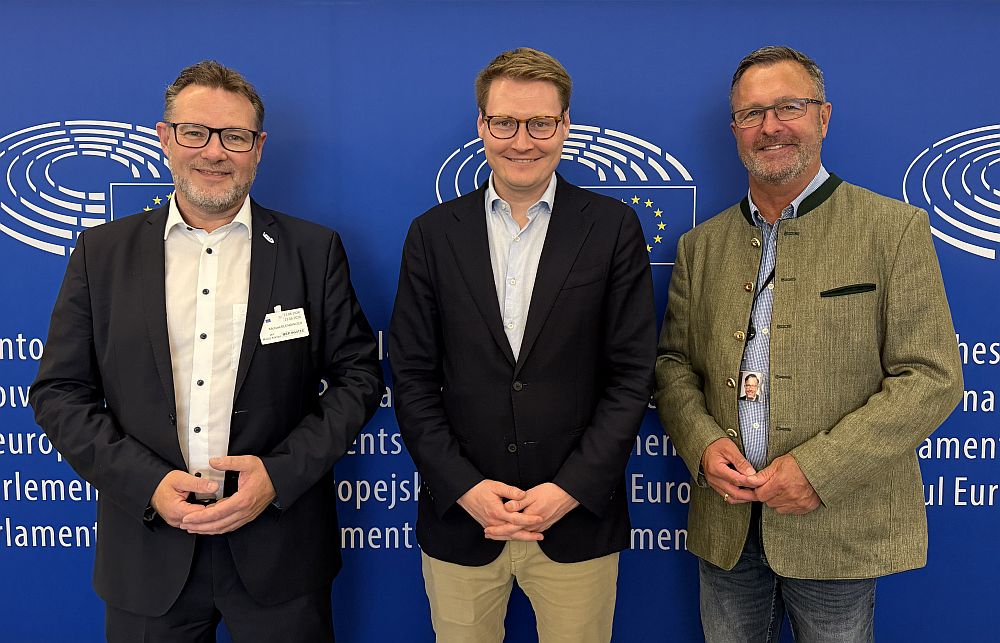
f.l.t.r. Michael Blendinger, Moritz Körner (MEP), Peter Brass
AECAC stressed that new EU rules must clearly distinguish between the lawful firearms trade and illicit firearms trafficking. Additional administrative burdens on businesses operating lawfully should be avoided. A detailed discussion of individual provisions of the proposed trafficking directive was not yet possible, as parliamentary consideration of the draft had been postponed until 14 July 2026. Nevertheless, initial questions were raised, particularly concerning 3D printing.
The evaluation of the Firearms Directive and its specific impact on specialist firearms dealers and gunsmiths were also discussed. The constructive meetings strengthened existing contacts and reaffirmed the role of AECAC and VDB as knowledgeable interlocutors at European level.

f.l.t.r. Peter Brass, Verena Mertens (MEP), Michael Blendinger
AECAC will continue its dialogue with the Commission and its exchanges with Members of the European Parliament. Its objective remains to ensure that the interests of the lawful firearms trade are represented at an early stage in European legislative and evaluation processes.
AECAC in Brussels: Discussions with the European Commission and the European Parliament Read More »